Into the Jungle
- Tobias & Tiffany Hallwood

- Sep 24, 2019
- 9 min read
The next leg of our trip was a journey into the Amazon basin. Manu National Park is located in Southern Peru and due to its remoteness it is one of the best protected parts of the entire Amazon jungle! What makes Manu so unique is that it is made up of 3 climatic zones; the first located in the Andean mountains situated at about 4000m, the second is a cloud forest situated between 1000-3000m, and the third zone is the jungle situated at about 300m at its lowest point. Due to these three unique environments there is an abundance of life in this region.
To date the park boasts:
- 1025 species of birds
- 7 species of macaws
- 221 different mammals
- 8 species of cats
- 15 species of monkeys
- 155 species of reptiles
- 1307 species of butterflies
- 300 species of ants
- 50 species of beatles
- 200 species of fish
With more being discovered each year! (Check out the end of this post to see what we saw during our trip!)
In addition to a variety of wildlife in Manu there are also a number of nomadic "no contact" tribes. Meaning that in the 80% of the protected park area, which is off limits to tourists, there are still small groups of indigenous people that have no contact with the outside world.
Manu National Park is divided into three zones:
1. Zona Natural, comprising 80% of the park and off limits to all unauthorized visitors.
2. Zona Reservada, comprising 10% of the park and is open to travelers.
3. Zona Cultural, comprising 10% of the park and is where most of the visitor activity is concentrated.
For these reasons we decided that it was worth the time and effort to get as deep into Manu National Park as we could, going to the Zona Reservada. We decided to use a company called Vilca Expeditions. We were really happy that there were only 3 of us in total on the trip.
Day 1:
Our journey began with a 6:30am pick up at our hostel. Day 1 was a long day. 11.5 hours on a bus to be exact. Our bus journey took us high up into the Andes and through one of the checkpoints of the park. From there we wound our way down through mountains along a small dirt road. At times as we took corners it seemed like the bus tires might slip over the edges of the road. The further we continued down, the warmer it got and the denser the trees became. Along the way we kept a look out for any signs of movement in the trees. During that journey we were lucky enough to spot a cock of the rocks, a bright red bird, which is the national bird of Peru. We also saw a troop of woolly and brown capuchin monkeys, and too many butterflies to count.
Our day ended at one of the simple lodges owned by Vilka, the tour agency that we booked with. The lodge was located just outside the town of Pillcopata in the secondary forest.
Day 2:
Day 2 began with a short early morning walk around the lodge grounds. During that walk we saw a variety of different birds, a number of different fruits and vegetables growing, different plants such as cocoa, coffee, and coca (used for altitude sickness and contains the alkaloid to make cocaine). During the walk we also learned about the different medicinal properties and uses of some of the plants, for example there is a subspecies of custard apple which is being studied for its uses to treat cancer or how the coca plant can be used as a numbing agent for dental work.
After breakfast we set out for the tiny town of Atalaya. Where we stocked up on a few supplies and hopped into a boat. Our boat journey took us down the Rio alte Madre de Dios. This section of Manu National Park was known as the Zona Cultural, a buffer zone where people are allowed to live and farm. This zone was also where most trips into Manu took people. As for us, we still had a full day on the river to get to the entrance of the Zona Reservada.
As we cruised down the river we spotted herons and egrets drying their wings in the sun and diving for fish, different types of vultures circling in the distance and sparrows diving into the river for a drink. A few hours in we had a chance to swim in an area where a hot spring joins the river. Along the way we also passed small villages and settlements only accessible by boat, some of which have only had contact with the outside world within the last decade.
Finally, after around 7 hours on the river we reached Boca Manu. Boca Manu sits on the confluence where the muddy Manu river meets the clear Rio alte Madre de Dios, creating an interesting dance as the two rivers become one. This little settlement was our home for the night and also the last chance we had to charge our camera batteries and phones. A generator ran from 6-10pm at the lodge in Boca Manu. Once we got into the Reserve Zone there was no power and no generator!


Day 3:
Today was the day we finally made it into Manu National Park! However in order to get to our campsite and base for the next two nights, we had another full day on the boat.
We left Boca Manu just after 6am and started to make our way up the Manu river. After about 45 minutes we came upon a clay lick, a salt and mineral rich area where parrots and macaws gather to eat the clay. There were no macaws at the clay lick, however we were treated to what must have been over a 100 parrots! It was amazing to see the bright blue, green, and yellow fluttered around so much!


From the clay lick we continued up the river and made a quick stop at the rangers station to check into the park. From here we continued on our journey and eventually came to a stop along the river bank and began a short walk through the jungle to a small lake where we hoped on a catamaran and paddled around looking for any signs of animal activity we could find. It was 12pm by this point and hot, so we knew the chances would be low. However we did manage to see a black caiman, that was about 3 meters long, a few dozen turtles, a sting ray, and troop of monkeys! We eventually made our way back to the main boat and started up the river again. Over the course of the next few hours we slowly worked our way up river avoiding fallen trees and and shallow sections of the river. Along the way we spotted an abundance of birds including, a variety of macaws, white caiman lurking just below the surface, and even spotted an anteater swimming across the river and climbing up the river bank!


As the day drew on, the sound of thunder could be heard in the distance and soon flashes of lightning followed. As the heat and humidity broke and gave way to wind, we soon found ourselves getting wet as the rain rolled in. Soon the jungle seemed empty as all of the birds and animals took shelter. The boat slowed to a crawl as the driver navigated the already shallow channels with even more caution. After about an hour the rain finally let up and we were able to pick up speed and eventually make it to the campsite around 4pm.
The Paujil campsite sat about 100 meters off of the river, hidden in the trees. It consisted of a kitchen/dining area, toilet and shower area, and a few basic tents with thatched roofs above them. Inside each tent there were two beds with mosquito netting. It was basic, but perfect!


That evening Tobias went on a night walk, while Tiffany hung out in the tent reading and avoiding the spiders! During the course of the night walk Tobias saw 4 different types of frogs, bullet ants, a rat snake and 5 different types of spiders (none of which were a tarantula).


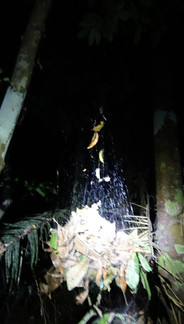


However, that night as they were getting ready for bed and Tobias was brushing his teeth outside of the tent, he turned around and spotted a small tarantula underneath their tent platform. (Tiffany did not find out about this until they were far from the jungle and having a beer in Boca Manu!)


Day 4
We woke up at 5:30 to the sounds of the jungle all around us. We spent the morning at Salvador Lake searching for the giant river otter. After striking out in the catamaran we decided to set up at one of the docks and wait it out there. After about an hour we finally saw them! It was a family of around 9. It was amazing to watch them fish in a pack and communicate with each other. It was easy to see where the name river wolves comes from!
From Salvador Lake we walked back to the river on a longer jungle path and along the way we came across a few troops of squirrel, brown capuchin and spider monkeys. We also learned about the spiralling fig tree that grows from the top of the canopy down by wrapping itself around another tree, eventually killing its host, and stealing its spot in the jungle!


That night we went for another night walk and Tiffany decided to brave the dark and to join us! We started this walk a little earlier and headed down to a lookout tower on Otorongo Lake. From the tower we were able to spot a few caiman. During our walk back we spotted a host of insects, frogs and a few scorpion spiders! Tiffany did not enjoy this experience and wished she had stayed in the safety of the tent enjoying a book. Now she knows for next time. Tobias however was enthralled with all the night animals and enjoyed taking photos of them.


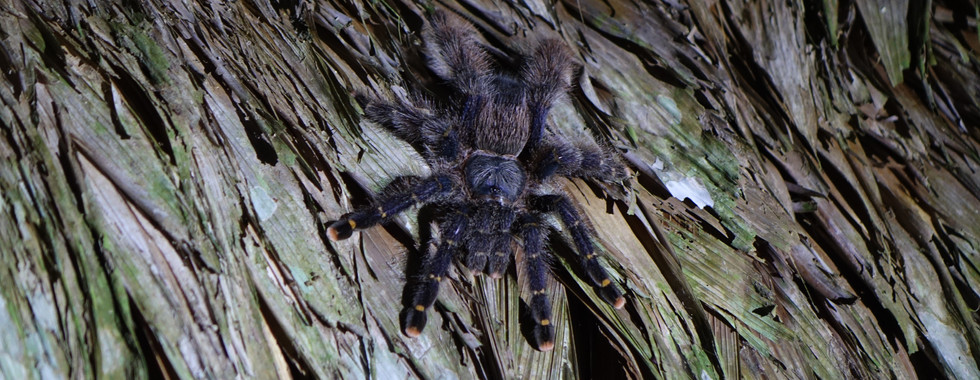
After dinner the other person on the trip, Lancelot showed Jose our guide the tarantula under our tent platform. Who was not impressed saying that was just a small male. He proceeded to then search for a larger one. Within a few minutes he found a large female on a thatched roof of one of the empty tents. The most impressive and scary thing about this was how easy it hid from us. Within a matter of seconds it was able to tuck itself into the leaves of the thatched roof and completely hidden! (Tiffany was in the safety of the tent with a book).




Day 5:
We woke up to the sound of rain after a night of thunder and lightning. We spent the morning walking in the jungle before hopping into the boat to begin our journey back down Manu river towards Boca Manu. The journey back was much faster not only because we were going down river but because the levels of the river had risen due to the rain over the last few days. Along the way we spotted two capybaras (world's largest rodents) on the river banks!

We stopped at the rangers station so that they could check the boat to make sure we weren't taking anything out of the jungle, like macaws or jaguars. While we waited for Jose, Lancelot and Tobias played football with some of the rangers and our boat operators. After a very hot sweaty game it was back on the boat for the last stretch to Boca Manu.
Day 6:
Due to the rains, the small jungle roads were likely flooded so we had to alter our plans for our final day. Instead of taking the boat to Shintya, a small village a few hours up the Rio alte Madre de Dios, where we were to catch a car back to Cusco. We had to take the boat all the way back to Atalaya, where we first started and a car from there. This meant what was supposed to be a 10 hour travel day turned into a 15 hour day. The rains continued throughout our boat trip to Atayala and even though the water levels had risen there were still sections so shallow that we had to be pushed. Along the way we also got a rare glimpse at some "non contact" people as they collected supplies left by rangers. (Due to the increasing number of outside people inhabiting the Cultural buffer zone, resources such as animals and plants in the area are decreasing so occasionally supplies are dropped off).
The car journey back to Cusco took us back up through the cloud forest and into the Andes. The drive through the cloud forest was particularly exciting because the rain meant the clouds were even thicker so the visibility was particularly bad. To add to that sections of the already narrow road had been washed away! On the bright side this long and harrowing journey meant that we got to listen to the drivers mp3 mix cd about 9 times, lets just say that after about the 4 time of hearing “Never Ending Story” you either grow to love it, has Tobias did or want to kill yourself as Tiffany did!

Our trip to Manu was incredible! Even though we didn't see a jaguar we got to go where most people don't and experience the Amazon jungle in its purest and almost untouched self. We definitely found it hard to leave Manu Reserve.

Sightings
Mammals
Red Squirrel
Tamandua anteater
Giant River Otter
Capybara
Monkeys
Woolly Monkey
Brown capuchin
Red howlers
Squirrel monkey
Black spider monkeys
Insects
Butterflies (all sorts of colors and sizes)
Owl moth
Giant grasshopper
Hairy caterpillar
Army ants
Bullet ant
Snakes
Whip snake
Rat snake
Caiman
White caiman
Black caiman
Spiders
Wolf spider
Banana spider
Tarantula
Social spiders (blind)
Scorpion spider
Birds
Snail bird
Osprey
Wide eyed parakeet
Dusky headed parakeet
Yellow crowned parrot
Blue headed parrot
Orange Cheeked parrot
Red and green Macaw
Blue and Yellow macaw
Scarlet macaw
Horned screamers
Green Ibis
Tropical king bird
White throated toucan
Sphinx quin (wild turkey)
Black caracara
Pied lapwing
Yellow billed tern
Black skimmer
Turkey Vulture
Yellow headed Vulture
Black Vulture
Golden Pendulum Orel
Orinoco goose
White winged Swallows
White banded swallows
Blue herons
Large billed heron
Yellow billed heron
Capped Heron*
Coycoy heron
Snowy egret
Great egret
Masked Falcon
Great black hawk
Sand nighthawk
Swallow tailed kite
Cormorant
Snake bird
Cock of the rocks
Jabiru Stork
wood stork
Amazon Kingfisher
Muscovy Duck
Orinoco goose
Red capped cardinal
Corasoa
Other
Stingray
Lots of different frogs
Yellow side necked turtle


Comments